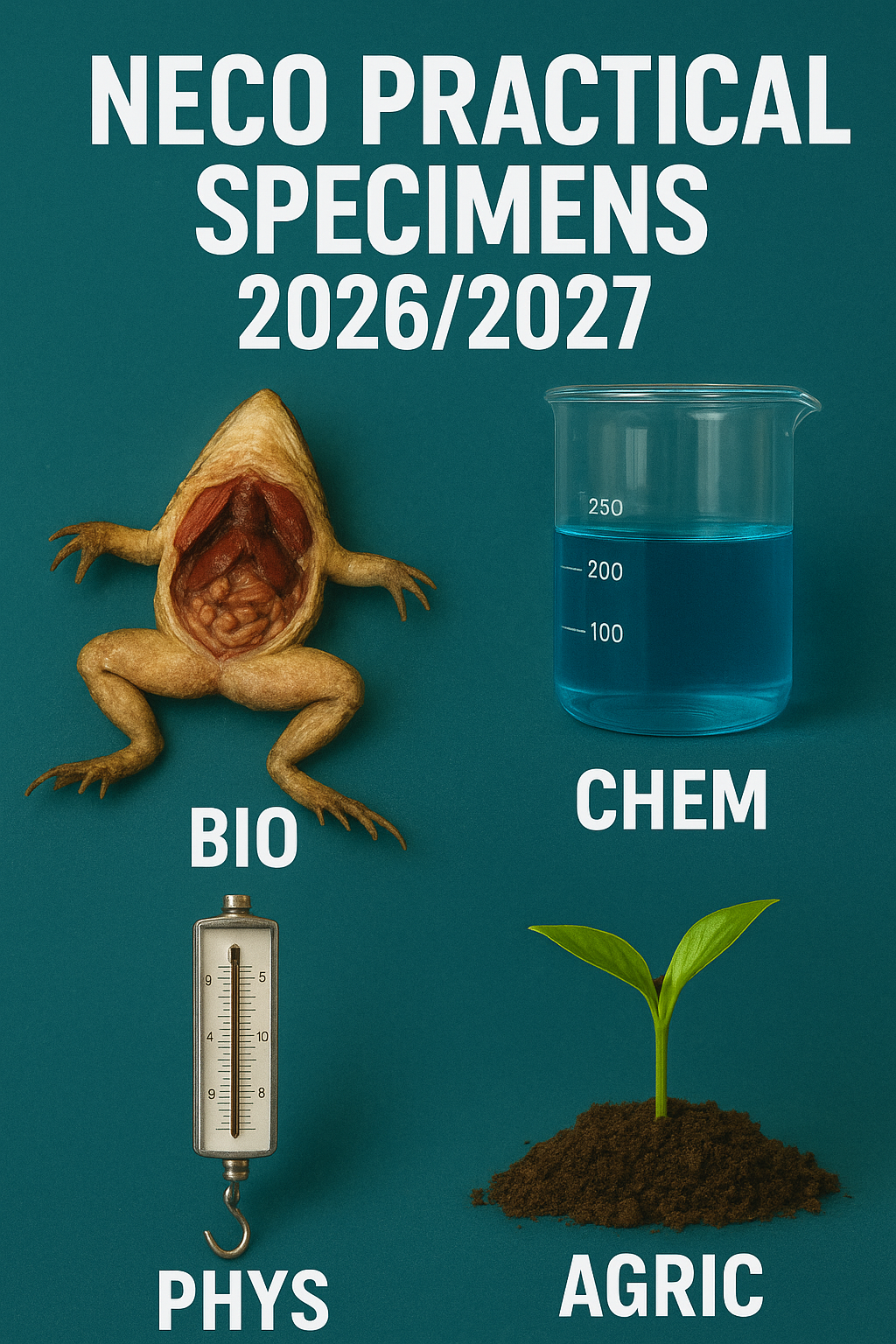
NECO Practical Specimens 2026/2027 For Bio, Chem, Phy & Agric Science
As a students preparing for the NECO 2026/2027 Practical Examination, and you are writing biology, Physics, and Agricultural Science. It is very essential knowing the NECO Practical Specimens 2026/2027 For Bio, Chem, Phy & Agric Science.
This article provides a detailed guide on what to expect, how to prepare for Bio, Chem, Phy & Agric Science practicals and answers to frequently asked questions to help candidates perform excellently.
This is is the Full list available NECO Practical Specimens 2026/2027 For Bio, Chem, Phy, Agric Science, and other science subjects. This guide will help you know what to expect in your practical exams and prepare better.
This is to inform all students participating in the National Examination Council NECO 2025 June July Senior School Certificate Examination SSCE that the full list of 2026/2027 NECO Practical Specimens for internal candidates has not yet been released. What we have here is for the Previous Session, but we promise to update as soon as they are released, so no panicking.
These specimens are for subjects such as Biology, Chemistry, Physics, Agricultural Science, Data Processing, Animal Husbandry, Computer Studies, Technical Drawing, Fisheries, and Visual Arts.
So lets get started
Contents
- 1 NECO Biology Practical Specimen 2026/2027
- 2 NECO Biology Practical Specimen
- 3 Specimen A – land Snail:
- 4 Specimen B: Toad
- 5 Specimen C – Spider
- 6 SPECIMEN D – CRAYFISH
- 7 SPECIMEN E SPIROGYRA FILAMENT
- 8 SPECIMEN F (MUCOR/RHIZOPUS)
- 9 SPECIMEN G (GROUNDNUT SEEDLING)
- 10 SPECIMEN H (MAIZE SEEDLING)
- 11 SPECIMEN I – MICROSCOPE
- 12 SPECIMEN L – AGAMA LIZARD
- 13 SPECIMEN N – TILAPIA
- 14 NECO Biology Practical FQ’S
- 15 NECO Physics Practical Specimen 2026/2027
- 16 uestion 1 Apparatus List
- 17 Question 2: Apparatus List
- 18 Question 3: Apparatus List
- 19 NECO Chemistry Practical Specimen 2026/2027
- 20 School Instructions
- 21 The Teachers Report
- 22 Titration requirements
NECO Biology Practical Specimen 2026/2027
Specimen A – Land Snail
Specimen B – Toad
Advertisements
Specimen C – Spider
Specimen D – Crayfish
Specimen E- Spirogyra Filaments
Specimen F – mucor/Rhizopus
Specimen G – Groundnut Seeding (A week old)
Specimen H – Maize Seedling (A week old)
Specimen I – Microscope
Specimen J – Slide (plain)
Specimen K – Pigeon
Specimen L – Agama Lizard
Specimen M – Rat
Specimen N – Tilapia.
NECO Biology Practical Specimen
Specimen A – land Snail:
Specimen A, belongs to the Phylum Mollusca and Class Gastropoda, inhabits various environments such as shrub lands, agricultural areas, plantations, gardens, and wetlands. It adapts to its habitats through observable features such as:
- Lungs: Utilizes lungs to breathe in oxygen, facilitating adaptation to land habitats.
- Shells: Possesses shells for protection.
- Tentacles: Uses tentacles for vision and sensory perception.
Specimen A holds economic significance through various factors. It serves as a crucial food source for mammals, birds, and earthworms. However, its presence poses a threat to farmers, causing significant agricultural damage.
On a more positive note, Specimen A contributes to ecosystem balance by aiding in the decomposition of rotten vegetation, particularly leaves. The species primarily feeds through scraping, targeting leaves and insects. Furthermore, Specimen A is hermaphroditic, with larger-shelled individuals predominantly identified as females.
Specimen B: Toad
Specimen B, belonging to the class Amphibia, thrives in wet, moist, and damp environments, including under stones, damp grass, and vegetation near freshwater ponds. Adaptations to its habitat include.
- Poison gland for protection.
- Warty skin for camouflage.
- Webbed digits of hind limbs for swimming.
- Bulging eyes for good vision.
- Muscular forelimbs for shock absorption.
- Long muscular hind limbs for jumping/hopping.
- Cryptic coloration for camouflage.
- Moist skin for cutaneous respiration.
Specimen B, an amphibian with a habitat in wet environments, employs tongue projection for feeding, capturing prey with its long, sticky tongue. Its economic importance lies in various ecological roles:
Predator-Prey Dynamics: Regulates populations of insects and invertebrates, contributing to a balanced predator-prey relationship.
Nutrient Cycling: Contributes to nutrient cycling through the consumption of prey and release of waste.
Indicators of Environmental Health: Serves as an indicator species, reflecting the health of ecosystems and indicating changes in water quality and habitat conditions.
Seed Dispersal: Facilitates seed dispersal by consuming fruits or seeds and excreting them in different locations, aiding in plant colonization and genetic diversity.
Prey for Predators: Acts as a food source for various predators, influencing energy flow and trophic interactions within ecosystems.
Genetic Diversity: Contributes to overall genetic diversity, enabling adaptation to changing environmental conditions and promoting ecological resilience.
Specimen C – Spider
Specimen C, belonging to the class Arachnida, exhibits adaptability to diverse habitats:
Leg Structure: Tailored for precise movements, aiding in habitat navigation.
Spinnerets: Silk-producing appendages enable essential web-building activities.
Chelicerae and Fangs: Specialized for efficient prey capture and venom injection during hunting.
Body Size and Shape: Varied to suit habitat requirements, optimizing adaptation.
Eyes: Adapted for enhanced visual capabilities and prey detection, promoting survival in diverse environments.
Its habitats includes forests (temperate and tropical), grasslands, deserts, wetlands (marshes, swamps), caves, mountains, and shrublands (scrublands).
SPECIMEN D – CRAYFISH
Specimen D, classified under the Arthropoda class, thrives in freshwater habitats such as streams, rivers, lakes, and ponds, exhibiting key adaptations:
Claws and Appendages:
Large, powerful claws for defense and prey capture.
Walking legs with specialized structures for movement and stability.
Exoskeleton and Body Shape:
Protective exoskeleton for defense: Compressed body shape for maneuverability in narrow spaces.
Antennae and Sensory Organs: Long antennae with chemoreceptors for chemical detection.
Sensory setae for perceiving movements and vibrations.
Abdomen and Tail: Uropods and swimmerets for swimming and stability.
Tail fan and telson for propulsion and protection.
SPECIMEN E SPIROGYRA FILAMENT
Specimen E, Spirogyra, resides in freshwater environments like ponds and lakes. It belongs to the Protista kingdom and Chlorophyta phylum. Its reproduction includes sexual reproduction through conjugation and asexual reproduction by fragmentation. Unfortunately, I cannot provide a labelled diagram here, but you may easily find one in biology textbooks or online resources for Spirogyra.
SPECIMEN F (MUCOR/RHIZOPUS)
Specimen F, Mucor/Rhizopus, thrives in moist or humid environments, specifically on decaying food substrates like bread, jam, jellies, fruits, and vegetables. It belongs to the Zygomycota phylum and exhibits various modes of reproduction:
- Asexual Reproduction: Occurs through sporangiospores.
- Vegetative Reproduction: Achieved by fragmentation.
- Sexual Reproduction: Involves conjugation.
SPECIMEN G (GROUNDNUT SEEDLING)
Specimen G, known as Arachis hypogaea (groundnut), belongs to the Kingdom Plantae, Phylum Tracheophyta, and exhibits epigeal germination. This germination type is characterized by cotyledons emerging above the soil. Examples of seeds that share this germination type include mango, orange, tomato, bean, castor oil, crotalaria, cashew nut, date palm, and flamboyant.
The process of epigeal germination involves the testa splitting, radicle emergence, downward growth of the radicle, appearance of lateral roots, elongation of the hypocotyl, pulling the cotyledons above the ground, leaving the testa in the soil, the bent-over hypocotyl carrying closed cotyledons for plumule protection, straightening of the hypocotyl, cotyledon split/opening, emergence of foliage leaves, and the growth of the epicotyl showing the apical bud.
Specimen G is a dicotyledonous plant with reticulate leaf venation, a taproot system, and is classified as an annual crop due to its life cycle.
SPECIMEN H (MAIZE SEEDLING)
Specimen H, identified as Zea mays (corn), belongs to the Kingdom Plantae and Phylum Tracheophyta. It undergoes hypogeal germination, where the cotyledon remains below the soil. Specimen H is classified as a monocotyledonous plant, featuring parallel leaf venation and a fibrous root system. It is categorized as an annual crop due to its life cycle
or the germination of seeds, the following conditions are necessary:
- Viable seed
- Moisture/water
- Air/oxygen
- Warmth/suitable temperature
- Light/sunlight
SPECIMEN I – MICROSCOPE
To be successfully examined using brightfield microscopy, a specimen must meet two essential requirements: it should undergo “fixation” to preserve cells and elements in a life-like state, and it should be transparent rather than opaque, allowing light to pass through for optimal visibility.
SPECIMEN L – AGAMA LIZARD
Observable Differences Between Specimen B (Toad) and Specimen L Agama Lizard
Specimen L, identified as a member of the Reptilia class, primarily inhabits walls, cracks, and mountain slopes. Observable similarities between Specimen B (Toad) and Specimen L (Agama Lizard) include a wide terminal mouth, two pairs of four limbs (forelimb/hindlimb), tympanic membrane/eardrum, presence of a trunk, eyes, head, and nostrils.
The specimen L, identified as a male Agama Lizard, exhibits distinctive characteristics justifying its gender. These include its brightly colored appearance with a redhead, blue-black trunk, a blue and orange tail, the presence of a Gular fold, and a prominent Nuchal crest. These features align with typical male attributes of the species.
Specialized feeding strategies include a sit-and-wait approach, lightning-fast strikes, strong jaws for gripping prey, and swallowing prey whole. These adaptations collectively contribute to the Agama Lizard’s survival and feeding efficiency in its natural environment.
SPECIMEN N – TILAPIA
Habitat: Freshwater lakes, ponds, and rivers/ Marshes, swamps, and estuaries/ Coastal waters with varying salinity/ Aquaculture systems (fish
ponds, tanks, cages).
NECO Biology Practical FQ’S
specimen A – land Snail:
Specimen A, belongs to the Phylum Mollusca and Class Gastropoda, and inhabits various environments such as shrublands, agricultural areas, plantations, gardens, and wetlands. It adapts to its habitats through observable features such as:
Specimen A – Land Snail
Specimen B – Toad
Specimen C – Spider
Specimen D – Crayfish
Specimen E- Spirogyra Filaments
Specimen F – mucor/Rhizopus
Specimen G – Groundnut Seeding (A week old)
Specimen H – Maize Seedling (A week old)
Specimen I – Microscope
Specimen J – Slide (plain)
Specimen K – Pigeon
Specimen L – Agama Lizard
Specimen M – Rat
Specimen N – Tilapia
Prepare for your biology lab practical exam with these concise tips:
Review lab procedures and protocols.
Thoroughly go over lab data and results.
Learn key terms and concepts.
Practice techniques and procedures.
Familiarize yourself with lab equipment.
Specimen A – land Snail:
Specimen A belongs to the Phylum Mollusca and Class Gastropoda,
Specimen B: Toad
Specimen B, belonging to Amphibia class, thrives in wet, moist, and damp environments, including under stones, damp grass, and vegetation near freshwater ponds.
NECO Physics Practical Specimen 2026/2027
uestion 1 Apparatus List
For Question 1 in the Neco Physics Practical Examination, the following apparatus are essential:
- Metre rule: For linear measurements.
- Retort stand and clamp: Provides stable support.
- Pointer: Enables accurate readings.
- Plasticine: Stabilizes objects during experiments.
- Spiral spring: Utilized in spring constant and oscillation experiments.
- Mass hanger: Suspends masses during experiments.
- Masses of 50, 70, 90, 110, and 130g are needed for weight and mass-related experiments.
- Stop watch/clock: Ensures precise timing of experiments.
Question 2: Apparatus List
- Rectangular glass block: For refraction and optics experiments.
- 4 optical pins: Marking points on the glass block.
- Drawing board: Flat, stable surface for drawing and experimentation.
- Drawing papers: For sketching diagrams and recording observations.
- Protractor: Essential for accurate angle measurements.
- 30 cm ruler: For linear measurements.
- 4 drawing pins: Securing drawing paper on the drawing board.
Question 3: Apparatus List
- Resistance box: Varied resistance control in electrical circuits.
- Rheostat: Adjusting current in circuits.
- Ammeter (0-1 A): Measures electric current.
- 2 V Accumulator or two 1.5 V dry Leclanche cells: Power source.
- 10 connecting wires: Establishes electrical connections.
- Torch light bulb: Used as a load in the circuit.
- Key: Opens and closes the electrical circuit.
NOTE: Ensure information confidentiality to maintain the integrity of the examination.
In addition to standard Physics laboratory apparatus, candidates need Mathematical tables, Graph paper, and Geometrical instruments.
Candidates should be informed that if they cannot proceed with an experiment after 15 minutes, they can seek assistance from the Physics teacher.
The teacher is allowed to provide hints or assistance, adhering to strict regulations, including not announcing hints to all candidates.
Candidates in need of help must approach the teacher personally, and the Examiner will be informed of any assistance given.
The Report Form must document details of apparatus, specific difficulties faced by candidates, any deviations from prescribed items, and assistance provided, including candidate details.
If multiple sets of apparatus are provided, they should be marked and reported clearly. A completed Report Form must be enclosed in each script envelope
NECO Chemistry Practical Specimen 2026/2027
School Instructions
- Preserve confidentiality: Prevent any direct or indirect communication of the provided information to candidates before the exam.
- Required materials: Candidates must have standard chemistry lab equipment, a 50cm³ burette, a 20cm³ or 25cm³ pipette (uniform for all candidates in a center), filtration apparatus, and reagents for qualitative work.
- Additional Apparatus Candidate supplies: Each candidate receives a corked flask labeled ‘An’ with 150 cm³ of tetraoxosulphate (VI) solution and another labeled ‘Bn’ with 150 cm³ of Na2C03 solution.
The Teachers Report
The Teacher’s report must specify the concentrations of solutions A and B, with candidates using the concentrations provided in the question paper.
No substitutions: Candidates are not allowed to substitute any substance or solution mentioned in the instructions.
Arrangement of candidates: Assign serial numbers to candidates in the laboratory in sequential order based on the examination number.
Specimen numbering: Ensure each candidate’s specimen numbers continue without repetition throughout the sets.
Division into sets: If candidates are in sets, maintain a continuous serial number to avoid repetition.
Record information: Candidates must note their serial numbers and registration numbers on the front page of their answer booklets at the start of the examination. Enclose a completed Teacher’s Report form with each script envelope.
Titration requirements
- (a)One burette (50cm³)
- (b) One Pipette (20cm³ or 25cm³)
- However, all candidates in a centre must use pipettes of the same volume
- (c) The usual apparatus for filtration
- (d) The usual apparatus and reagent for qualitative work including:
- (i) Dilute sodium hydroxide solution
- (ii) Dilute ammonia solution
- (ii) Dilute hydrochloric acid
- (iv) Barium Chloride solution
- (v) Distilled water
- (vi) Red and blue litmus paper
- (vi) Phenolphthalein
- (vii) Methyl orange
- (ix) One boiling tube
- (x) Five test tubes
- (xi) Source of heat
- (xi) Wash bottle containing distilled water
- (xii) Filtration apparatus
- 3. Each candidate should be supplied with the following:
- where ‘n’ is the candidate’s serial number
- (a) 150 cm³ of tetraoxosulphate (VI) solution in a corked flask or bottle labelled ‘An. These should all be the same containing 2.20cm³ of
- concentrated tetraoxosulphate (Vi) acid per dm³ of solution.
- (b) 150 cm3 of Na2C03 in a corked flask or bottle labelled ‘Bn’. These should all be the same containing 3.6 g of sodium trioxocarbonate (IV)
- pellet per dm3 of solution.
- (c) One spatula of Na2C03 in a corked
- specimen bottle labelled ‘Cn’. Note ‘n’ is the candidate’s serial number.
- In all cases, more materials may be given if required
Conduct the required titration for question one, recording titre values with at least one decimal place on the Teacher Report Form, verifying them before documentation.
Report difficulties: Report any challenges faced by candidates, especially those not evident in the scripts.
- Include a completed Teacher’s Report form in each script envelope; this form is provided separately.
- Perform the required titration for question one, recording titre values with at least one decimal place in the designated spaces on the Teacher Report Form. Ensure the values are verified before recording.
- Report any difficulties experienced by candidates, particularly those not apparent from the scripts.
You must prepare thoroughly for chemistry practical exams by mastering the concepts, theories, and formulas relevant to each experiment. Familiarize yourself with the aim of each experiment to enhance your recall of the procedures during the examination.
- How To Register For NECO 2026/2027 Fees, Deadline & Requirements
- NECO GCE Registration Form 2026/2027 Guidelines For Nov/Dec Application.
- How to verify NECO Result Online 2026/2027 Using Token
- How To Change Name On NECO Result 2026/2027
- How to Buy NECO Result Checker Token Price & Guidelines 2026/2027